Polymarket news trading looks easy on a chart: a headline lands, the price jumps 15 cents in a minute, and anyone who bought just before it made 15 cents a share. We tested four ways to trade that pattern in 2026. Following a news move a minute late and selling 1 to 24 hours later returned -13% to -23%. Copying wallets that were early on past news did no better than copying similarly active wallets, and copying new wallets that agree lost money too. The only big win, a 5-second news trading bot at +$2.63 per $10, came from a look-ahead bug in our first backtest.
The event-level data and a script that recomputes the results are in the Polymarket news trading backtest on GitHub.
Polymarket news trading results
| Idea | What we tested | Result |
|---|---|---|
| A 5-second news bot | 1,218 of 4,303 price shocks that had a later price, Sept-Oct 2026 | +$0.18 per $10 at the price 2-15 min later, before exit costs (t 1.5); -$0.34 held to resolution |
| The same bot with a look-ahead bug | 510 of 923 moves picked by where the price went later | +$2.63 per $10 (t 10.1): not real |
| Follow a news move a minute late | 1,713 moves of 10 cents or more, May-Oct 2026 | -13% to -23% of the stake when sold 1 to 24 hours later, in both test periods |
| Copy wallets that were early on past news | 3 windows, 120 to 417 wallets, copied mid-Aug to Oct | No better than a control group of similarly active wallets |
| Copy new wallets that agree | 1 to 6 new wallets on the same side, Sept-Oct 2026 | -7.2% to -4.9% of the stake after fees |
The first three tests cover non-sports event markets: politics and elections, geopolitics, economics, technology, culture, crypto events and other event markets; the first two leave out markets that count mentions or posts. The fourth test covers all markets. Tests 1 to 3 use prices observed after the signal, test 4 uses the K-th wallet's own average price plus 1 cent, and all tests include Polymarket's taker fee.
A 5-second Polymarket trading bot on news, and the look-ahead bias
We started with a news bot. Polymarket prices react to posts and headlines, and a bot that sees the first trade of a move can buy within seconds. We measured it on 30 days of markets, September 14 to October 14, 2026.
Our first version of the backtest defined a "news jump" as a move that held: the price 2 to 15 minutes later had to be at least 10 cents away from where it started. It then bought 5 seconds after the first trade of the move. That version made +$2.63 per $10 valued at the later price, with a t-statistic of 10.
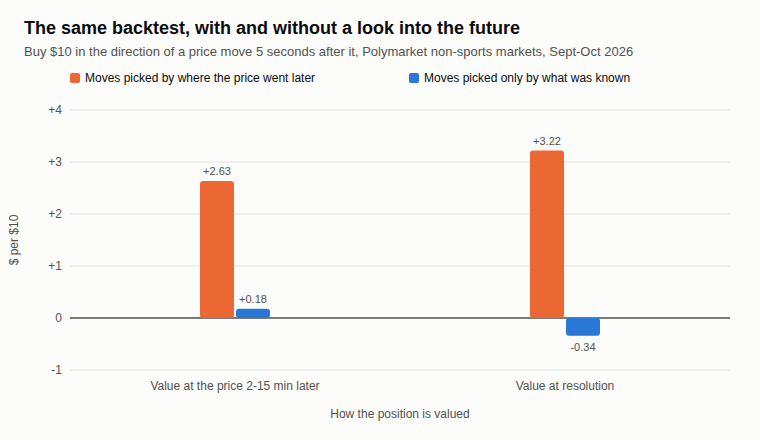
The bug is in the definition, a textbook case of look-ahead bias. A move counts as a jump only if the price is still there minutes later, so the test only buys moves that are already known to continue. A live bot sees the first trade, not the price 15 minutes later. In that version, 88% of the "jumps" had moved further by the time they were valued, because that is how they were chosen.
The honest version picks a move only from what is known at the moment: the first trade at least 5 cents away from the median price of the previous 5 minutes. On the same markets, 4,303 such shocks qualified, and 1,218 had a trade 5 seconds later and enough later trades to value the position. Buying 5 seconds after the shock made +$0.18 per $10 at the later price (t 1.5), before any cost of getting out. Held to resolution it lost $0.34 per $10. Where a later price existed, the price had moved further in the same direction only 37% of the time.
Following a Polymarket news move a minute late
Most traders are slower than 5 seconds. So we built a detector that uses only past data. At each minute it compares the volume-weighted price of the last 3 minutes with that of the hour before, leaving out the last 10 minutes, and fires when the gap is 10 cents or more. It then buys the rising side over the next 3 minutes, pays 2 cents of slippage and the taker fee, and sells after 1, 4 or 24 hours, or holds to resolution. We fixed these rules before looking at any result.
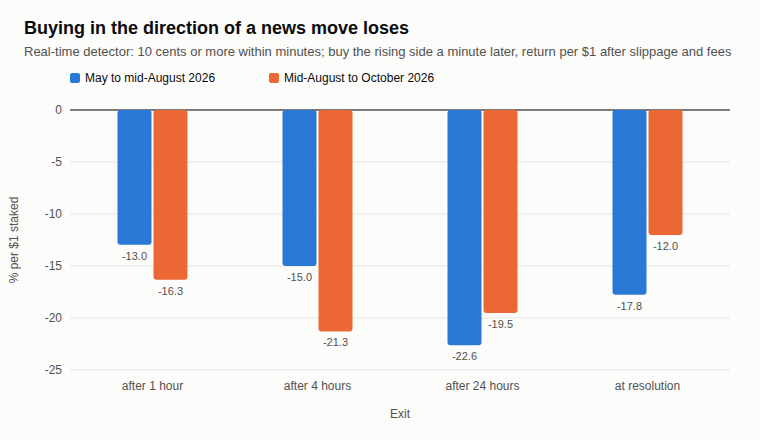
| Exit | Return on the stake, May to mid-August (1,346 moves) | Return on the stake, mid-August to October (367 moves) |
|---|---|---|
| After 1 hour | -13.0% (t -6.7) | -16.3% (t -6.9) |
| After 4 hours | -15.0% (t -6.7) | -21.3% (t -7.7) |
| After 24 hours | -22.6% (t -11.5) | -19.5% (t -4.8) |
| At resolution | -17.8% (t -5.2) | -12.0% (t -1.7) |
A minute after a news move, most of it has already happened, and buying the rising side lost money at every exit in both periods. Betting against the move did not work either: it lost after 1 and 4 hours in both periods, and at resolution it made +11.4% in the first period and -13.5% in the second.
Copying Polymarket insiders: wallets that bought before the news
If the price moves on news, someone may have bought before it. That is the Polymarket insider idea: find wallets that were early on past news and copy their next trades. We took 1,047 news jumps of 15 cents or more that kept two thirds of the move 1 to 4 hours later, on politics, geopolitics, economics, technology, crypto and other event markets with at least $50,000 of volume, from May 1 to October 21, 2026, after removing sports and price-target markets.
For each jump we listed who bought the rising side in three windows: 24 hours to 2 minutes before, 2 hours to 2 minutes before, and in the first minutes of the move. On jumps before August 16 we picked the wallets that bought early on at least three different events and were on the rising side at least 75% of the time. A control group met the same minimum activity without that record. Then we turned each group's buys of $100 or more on one side of a market, from August 16 to October 21, into one signal per market and side, and copied a signal at a later price that another trader actually paid shortly after, a few cents worse at most, with the taker fee. A copy was possible for 14% to 20% of the signals (468 to 769 per group); the rest had no such later trade or were at extreme prices.
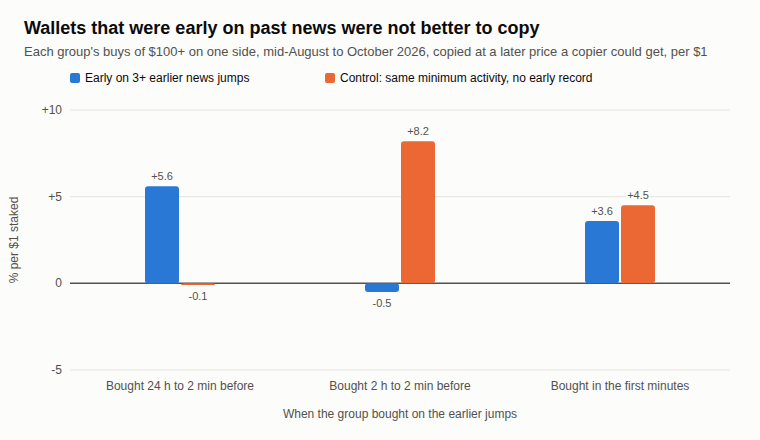
| When they bought on the earlier jumps | Early wallets: copy return | Control: copy return |
|---|---|---|
| 24 hours to 2 minutes before | +5.6% (t 1.3), +0.7% without the 3 largest events | -0.1% |
| 2 hours to 2 minutes before | -0.5% (t -0.1) | +8.2% (t 1.6) |
| First minutes of the move | +3.6% (t 0.8) | +4.5% (t 1.1) |
None of these returns is statistically different from zero, and the early groups do not beat the control. The last row shows why. Wallets that bought in the first minutes of earlier jumps kept doing it: on later jumps they were on the rising side 77% of the time, against 44% for the control. Copying them still returned about the same as copying anyone, because by the time a copier gets in, the fast wallet's price is gone. Our Polymarket insider score found the same thing from another angle: what repeats is the price a wallet pays, not knowledge of what is coming.
Copying new Polymarket wallets that agree
Alerts about fresh wallets piling into one outcome are a common post on X and Reddit. We took 86,228 wallets whose first trade was between September 1 and October 20, 2026, and looked for markets where K different wallets in their first 72 hours each bought at least $10 of the same side within 24 hours, for K from 1 to 6. We copied at the K-th wallet's average price plus 1 cent and held to resolution, net of each market's taker fee.
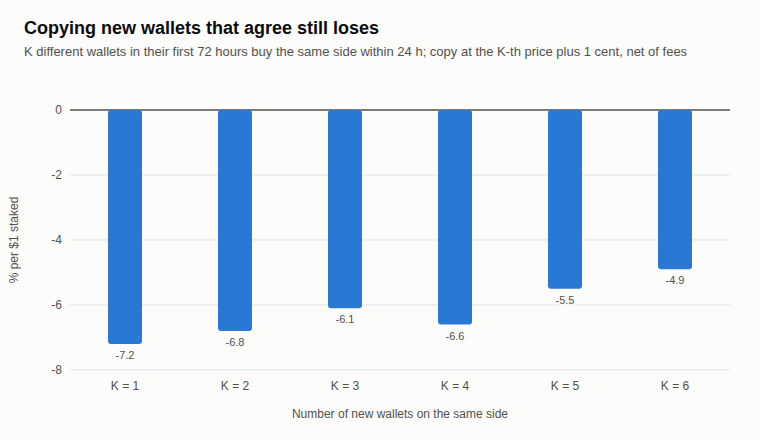
With one new wallet the copy lost 7.2% per dollar after fees (73,092 signals, t -19). More agreeing wallets shrank the loss, to 4.9% with six (8,598 signals), but it stayed a loss. It held in both months and in every segment (short Up or Down markets, sports and other markets), with one exception: 121 signals of six wallets in other markets made +8.8% (t 0.9), too few to mean anything. Before fees the copy lost 2.3% to 4.7%.
Why news trading on Polymarket is hard
On the markets we studied, prices reacted to news within seconds, so a trader who reacts in a minute buys after most of the move. Copying wallets that looked early on past news did not pay: the fast ones were already in by the time a copy could fill, and the best group's +5.6% fell to +0.7% without its 3 largest events. New wallets that agree with each other lose money as a group. And a backtest that chooses its events with information from after the event finds an edge that is not there, as our first version did.
Methodology
- Data. On-chain Polymarket trades in our database, May to October 2026.
- Markets. Tests 1 to 3: non-sports event markets. Test 1 removed sports (including season-long sports questions), short Up or Down markets, price-target markets, daily weather markets, and markets that count mentions or posts. Tests 2 and 3 removed sports, dated, price-target and weather markets by their names, and test 2 also mention and post-count markets. Test 4: all markets.
- Prices. Test 1 enters at the next trade 5 seconds after the shock, with no spread added, and values the position at the later price level (no exit cost) or at resolution. Test 2 enters at the minute volume-weighted price plus 2 cents. Test 3 uses a later price another trader paid. Test 4 uses the K-th wallet's own average price plus 1 cent, which is optimistic for a copier.
- Fees. The taker fee 0.05 × p × (1 - p) in tests 1 to 3, at or above Polymarket's rate on politics, economics and geopolitics markets (crypto event markets pay up to 0.07 and are a small share), and each market's own taker rate in test 4.
- Out of sample. Tests 2 and 3 fix their rules first and report two periods. The market cleaning of test 1, the removal of mention and post-count markets from test 2 and the -100% floor on returns in test 2 were added when preparing this release.
- Bots. Test 3 dropped wallets with more than 40,000 fills on one side in the check period, and test 4 dropped wallets with more than 5,000 trades by late October. Both filters use later activity.
- Statistics. Means per trade with plain t-statistics. Trades on the same event are not independent, so treat t values near 2 with caution.
- Known gap. Some trades in our table have an empty market id (5% to 18% of dollar volume outside the sports and Up or Down categories in some months of 2026, mostly in uncategorized sports and Up or Down markets, in an earlier check). Tests 1 to 3 joined trades on the market id and missed them, so their counts may be low; the signs of the results do not depend on it. Test 4 matched markets by asset id and is not affected.
Check it yourself
The repository has every price shock, every look-ahead jump and every detector trigger as CSV files, the aggregated results for the two copy tests, and scripts/summarize_news_trading.py, which recomputes the results in the tables above with the Python standard library. No wallet addresses are included.
What this release does not cover
- Reacting faster than 5 seconds.
- Sports, where in-play news (goals) is a different problem; see our late goals study.
- Market making around news.
Takeaways
- On the markets we studied, a news move was usually priced within seconds. Buying a minute later and selling 1 to 24 hours later returned -13% to -23%.
- Wallets that look early on past news were no better to copy than any active wallet.
- New wallets that agree with each other lose money as a group, and copying them loses more.
- If a news backtest looks great, check how it picks its events: our first version picked them by the price 15 minutes later.
FAQ
Can a Polymarket trading bot profit from news within seconds?
Not on the markets we studied. On 1,218 price shocks in politics, geopolitics, economics, technology, culture and other event markets from September to October 2026, buying 5 seconds later made +$0.18 per $10 valued at the price 2 to 15 minutes later (t 1.5), before exit costs, and lost $0.34 per $10 held to resolution. A first version that picked moves by where the price went later showed +$2.63 per $10: that was look-ahead bias.
Does it pay to follow a big news move on Polymarket?
No. A real-time detector flagged 1,713 moves of 10 cents or more on non-sports event markets from May to October 2026. Buying the rising side a minute after the move and selling 1 to 24 hours later returned -13% to -23% of the stake, in both periods we tested (May to mid-August and mid-August to October).
Can you copy Polymarket wallets that bought before the news?
Not profitably. We picked wallets that were early on the rising side of three or more earlier news jumps and copied their later buys at a price a copier could get. They returned +5.6%, -0.5% and +3.6% in three versions of the test, against -0.1%, +8.2% and +4.5% for a control group with the same minimum activity. None of the differences is statistically significant.
Should you copy new wallets that all buy the same side?
No. When new wallets in their first 72 hours bought the same side of a market within a day, copying them lost 7.2% per dollar after fees with one wallet (73,092 signals) and 4.9% with six (8,598 signals), in both September and October.
See also: Polymarket copy trading backtest on whales and Polymarket strategies that don't work. To see how individual wallets trade, open any address from the OrcaLayer leaderboard.
This is research, not financial advice.