Late in a level football (soccer) match, one team's live price on Polymarket jumps from 0.28 to 0.53 in a few seconds. It looks like a goal. Buy that team 2 seconds later and you lose money on average: across 837 such jumps in September and early October 2026, the result was -$2.85 per $10 (t -7.9).
We replayed two in-play ideas on a recorded order book of every Polymarket football market: buying a late jump at a level score, and protecting goal bets with a stop-loss. Neither one paid. Most fast jumps were pulled quotes, not goals. The jumps that looked clean lost money too, and stops fired so often (77 to 96% of bets at 3 and 5 cents) that they lost more than holding.
The event-level data, a script that recomputes every late-goal number, and the full stop-loss result grid are public in the Polymarket football late goal and stop-loss backtest on GitHub.
Polymarket live football results
| Idea | What we tested | Result |
|---|---|---|
| Buy a late jump at a level score | 837 jumps, 459 matches, 14 match days | -$2.85 per $10 at +2 s; the faster you buy, the more you lose |
| Buy only clean-looking jumps | 85 jumps with a tight spread | -$0.51 per $10 at +2 s, 76% won |
| Stop-loss on goal bets | 1,004 replayed signals, 463 live | Every one of 28 stop settings worse than holding on the replay; about the same as holding live |
Buying a late goal on Polymarket: 837 jumps
The rule came from a simple idea: late in a match with the draw as favorite, a sudden move toward one team usually means a goal, and a goal that late usually decides the match. We searched the recorded order book for that pattern.
A jump counts when, about the 70th minute or later, the draw was the favorite 30 seconds earlier and one team's Yes price rose by 0.25 or more within 30 seconds to 0.50 or higher. That happened 837 times in 459 matches on 14 days between September 17 and October 5, 2026 (September 30 to October 4 were not scanned). The jumping team went on to win 380 of them, 45%.
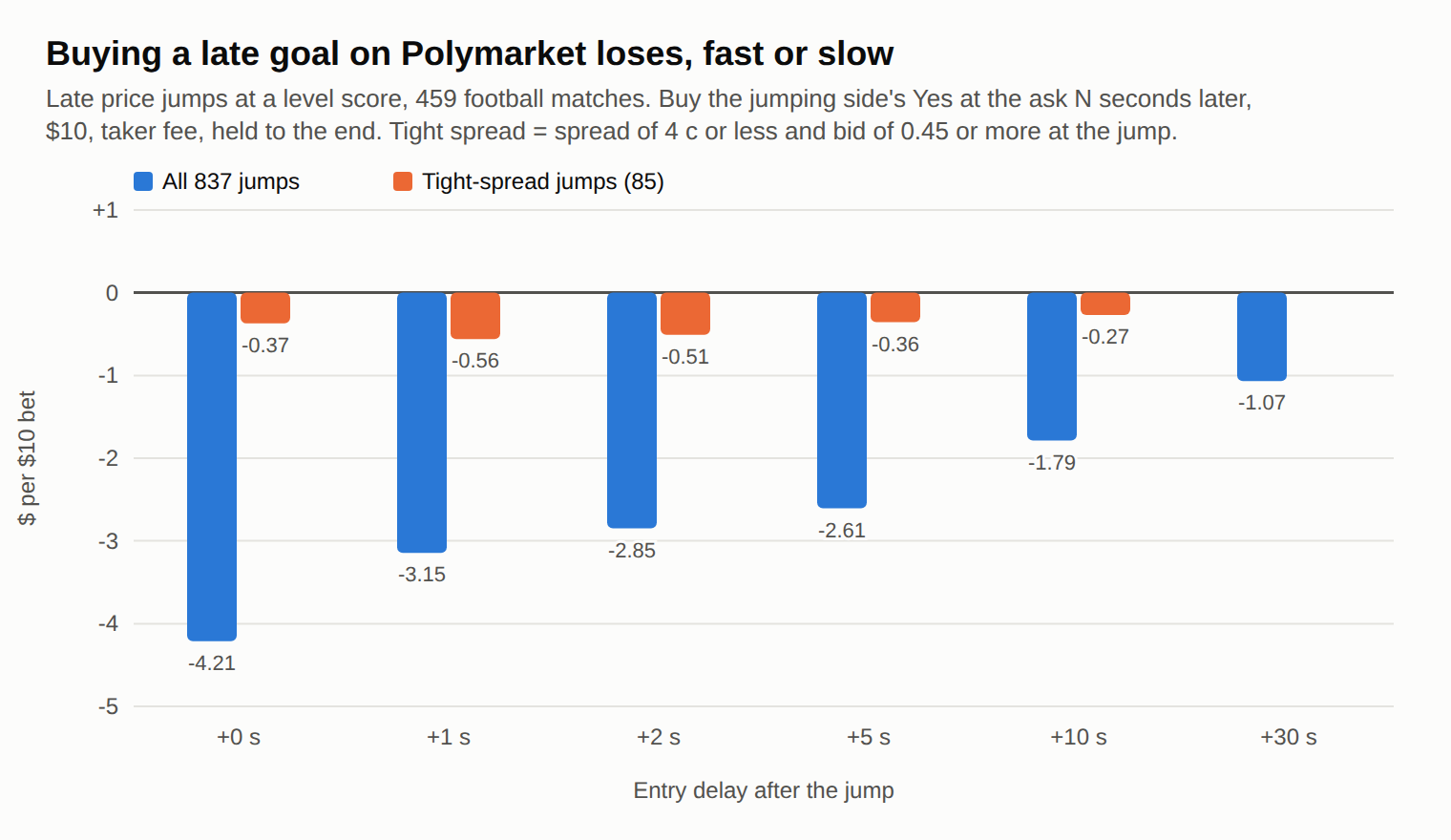
Then we bought that team at the best ask a few seconds after the jump, $10 per bet, paid the sports taker fee, and held to the end:
| Entry after the jump | Result per $10 | t | Bets |
|---|---|---|---|
| 0 s (not reachable) | -$4.21 | -18.2 | 762 |
| 1 s | -$3.15 | -9.6 | 800 |
| 2 s | -$2.85 | -7.9 | 806 |
| 5 s | -$2.61 | -6.5 | 810 |
| 10 s | -$1.79 | -3.8 | 810 |
| 30 s | -$1.07 | -1.9 | 794 |
Polymarket holds a taker order for 1 second in live football before it can match, so +2 seconds is a realistic entry for a fast bot. Every row loses, and the earliest entries lose the most, because the first seconds after a jump are when the price is most wrong in the direction you are buying.
Most fast Polymarket price jumps are not goals
The spread at the moment of the jump separates the two cases, and it is known at once. When a real goal happens, both sides of the book move together and the spread stays tight. When one side of the book is simply pulled, the mid-price jumps but the bid stays behind, and the spread is wide.
| Spread at the jump | Jumps | Jumping team won | Result at +2 s per $10 |
|---|---|---|---|
| 0 to 2 c | 34 | 82% | +$0.68 (t +0.6) |
| 3 to 4 c | 51 | 73% | -$1.30 (t -1.6) |
| 5 to 8 c | 60 | 73% | -$0.69 (t -0.8) |
| 9 to 19 c | 65 | 68% | -$0.92 (t -1.1) |
| 20 c and more | 627 | 36% | -$3.56 (t -7.8) |
Three jumps out of four had a wide spread, and in those the "scoring" team won only 36% of the time. Most of those look like quotes pulled from one side of the book. The repository walks through two cases second by second: a 55-cent spread jump in a match that ended in a draw, and a 1-cent spread jump that was only bids coming back in a match one team already led.
Clean-looking jumps on Polymarket pay nothing either
Keeping only jumps with a spread of 4 cents or less and a bid of at least 0.45 leaves 85 with a tight book at the jump. The jumping team won 76% of them. Buying them still lost money on average:
| Entry after the jump | Result per $10 | t |
|---|---|---|
| 0 s | -$0.37 | -0.6 |
| 1 s | -$0.56 | -0.9 |
| 2 s | -$0.51 | -0.8 |
| 5 s | -$0.36 | -0.5 |
| 10 s | -$0.27 | -0.3 |
None of these is statistically different from zero. Sixty seconds after the jump, the ask was a median of 1 cent above the +2-second entry (25th to 75th percentile: 0 to 3 cents), so there was nothing left to gain after the jump.
A tight spread is not proof of a goal either. The "level score" 30 seconds before the jump is read from mids too, and pulled quotes can fake it in a match one team already leads. When all three books are two-sided, the three mids add up to about 1.00; in 51 of these 85 jumps they added up to more than 1.10. Only 19 of the 85 had a clean book before the jump, and they returned -$0.65 per $10 at +2 seconds (t -0.4), too few to say more.
Polymarket stop-loss on goal bets: worse than holding
The second idea tries to rescue a goal-signal strategy: buy when the book moves like a goal, and if the move turns out to be false, sell at a stop instead of riding the loss to the end.
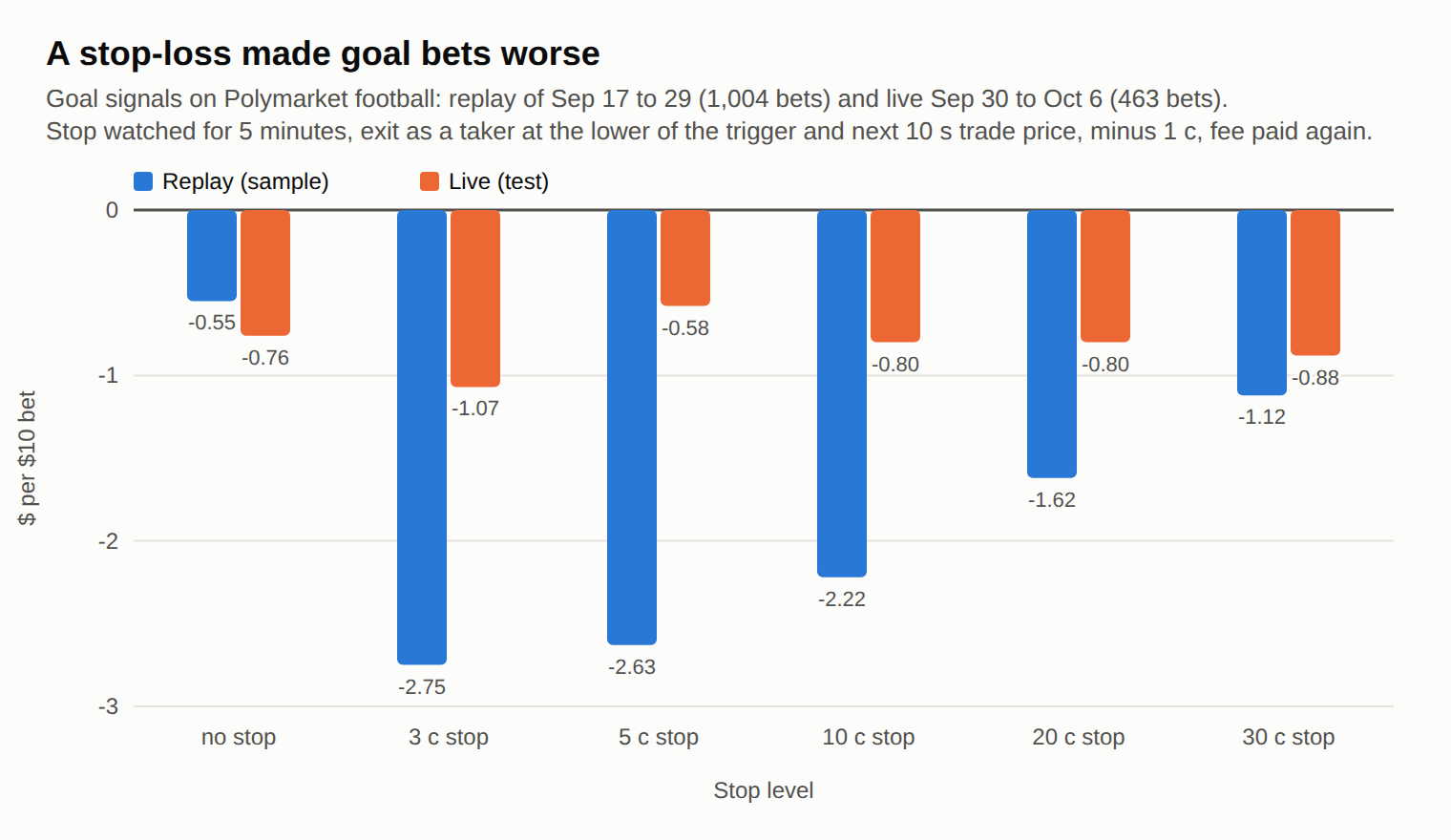
We tested it on the goal detector from our first issue, entering at the recorded ask 1 second after each signal. A stop of X cents below the entry, watched for a window of W minutes, triggers on the first trade at or below that level; we then sell as a taker at the lower of the trigger price and the average trade price of the next 10 seconds, minus 1 cent, paying the fee again. Without a trigger we hold to the end. The grid was 7 stop levels (3 to 30 cents) times 4 windows (2, 5, and 15 minutes, and to the end of the match).
| Stop | Replay per $10, 1,004 signals (Sep 17 to 29) | Live per $10, 463 signals (Sep 30 to Oct 6) |
|---|---|---|
| none | -$0.55 | -$0.76 |
| 3 c, 5 min | -$2.75 | -$1.07 |
| 5 c, 5 min | -$2.63 | -$0.58 |
| 10 c, 5 min | -$2.22 | -$0.80 |
| 20 c, 5 min | -$1.62 | -$0.80 |
| 30 c, 5 min | -$1.12 | -$0.88 |
| best of 28 settings | -$1.07 (30 c, 2 min) | -$0.58 (5 c, 5 min) |
On the replay, every one of the 28 stop settings did worse than holding. On the live signals that came later, four settings were a little better than holding, within noise, and the rest were the same or worse; stops watched to the end of the match lost $0.39 to $0.93 per $10 more than holding. On the replay, a 3-cent stop fired on 86 to 96% of all bets and a 5-cent stop on 77 to 92%, because prices in live football often move several cents within a few minutes.
Why stop-losses fail in live football markets
A stop sells after the price has already dropped. In live football that drop is often temporary: an attack that comes to nothing, a pulled quote, or even a real goal that briefly overshoots. The stop turns each of those dips into a realized loss and gives up the bets that would have recovered. On top of that, Polymarket has no stop orders, so every exit is a market sell after the 1-second taker delay, and it pays the taker fee a second time.
Here the entries were already negative before any stop: -$0.55 per $10 on the replay and -$0.76 live.
Methodology
- Order book: our own recorder of the Polymarket CLOB WebSocket for every football market since September 17, 2026, checked against on-chain trades (99.9% of trades present, 97.6% at the recorded best price).
- Late jumps: 1X2 markets ("Will X win", "end in a draw"), wall clock at least 87 minutes after kick-off (about the 70th minute of play), draw the highest of the three mids 30 seconds before, the side's Yes mid up by 0.25 or more within 30 seconds to 0.50 or higher, one detection per side per match per 10 minutes (duplicates from overlapping day files removed). Asks are taken after the first book update at or after each offset; spreads are rounded to the cent. Results from market resolution.
- Bets: $10 at the recorded best ask, only asks above 0.02 and up to 0.97, sports taker fee 0.05 x p x (1 - p) per share, held to resolution.
- Stop-loss: goal signals from our goal detector (several linked markets of a match repricing at once, as in our first issue) at three sensitivity settings; one goal can fire more than one setting, and every signal is counted as a bet. Replayed from September 17 to 29 and run live from September 30 to October 6. Entry at the recorded ask +1 s; stop triggered by on-chain trades; exit at the lower of the trigger price and the volume-weighted trade price of the next 10 seconds, minus 1 cent, minus the fee. The data file also has a "strong signals" subset and the 70th-minute-and-later subsets.
- Statistics: mean result per $10 and its plain t-statistic. Bets in the same match are not independent (837 jumps in 459 matches), so treat t values near 2 with caution.
FAQ
Can you profit by buying after a late goal on Polymarket? Not in our data. Across 837 late price jumps at a level score, buying the jumping side 2 seconds later lost $2.85 per $10 (t -7.9). Even on the 85 jumps with a tight spread at the jump, the result at +2 seconds was -$0.51 per $10 (t -0.8).
Why do late price jumps on Polymarket mislead? Most of them are quotes pulled from one side of the book, not goals: 627 of 837 jumps had a spread of 20 cents or more, and the jumping side won only 36% of those. Even a tight spread is not proof, because pulled quotes can also fake the level score before the jump.
Do stop-losses help on Polymarket football goal bets? No. On 1,004 replayed goal signals, every one of 28 stop settings did worse than holding: -$1.07 to -$2.87 per $10 against -$0.55 without a stop. On 463 later live signals, stops were about the same as holding, none clearly better.
Why do stop-losses fail in live football markets? Prices swing hard during play, so a stop fires on noise and on real goals that bounce, and you sell after the drop at a taker price with a fee. Polymarket has no stop orders, so the exit is always a market sell.
What we did not test
Pre-match markets, other sports, and stops on strategies whose entries make money. Someone who sees the goal before the book moves is in a different game; our first issue showed such wallets exist and cannot be copied after the fact.
Takeaways
- Before treating a fast jump as a goal, check the spread: 627 of 837 jumps had a spread of 20 cents or more, and that side won only 36% of them.
- Check the book before the jump too: if the three mids add up to well over 1, the level score itself may be pulled quotes.
- Test a stop-loss against holding on the same signals. On our replay, all 28 settings lost more than holding.
- Check that the entries make money without a stop first. Ours lost $0.55 per $10 on the replay before any stop was added.
You can look at live Polymarket football markets and the wallets trading them on the OrcaLayer leaderboard, and pull full trade histories from the OrcaLayer API. This is the third issue of our negative-results series. Earlier: Polymarket strategies that don't work and Polymarket copy trading: why top whales stop winning.
This is research, not financial advice. Results reflect our data and period (September 17 to October 6, 2026).