Polymarket insider trading makes headlines: a wallet buys a longshot a few hours before the news breaks, and the screenshot goes around. An insider tracker that flags such wallets automatically sounds useful, so we built a Polymarket insider score, called it the Early score, and tested it on 355,732 wallets before showing it to anyone.
We wrote the rules down first, scored the wallets on their trades from October 2025 to March 2026 (period A), and checked the same wallets from April to September 2026 (period B). The score passed its own test: six months later the price still moved toward the top 10% after they traded and against the bottom 10%. But most of that edge was already there one hour after the trade. What carried over from one half-year to the next was the price a wallet paid. Knowing what was coming barely showed up.
So we never released it: the score is not on the site, in the API or in MCP. The aggregated tables and a script that rebuilds the test on the OrcaLayer API are in the Polymarket insider score backtest on GitHub.
Polymarket insider score results
| Question | Result |
|---|---|
| Does the top 10% stay on top six months later? | Yes: +0.83 cents per entry after 24 hours (t 7.9); bottom 10% -0.76 (t -4.7) |
| Is it foresight? | Mostly not: +0.75 of the +0.83 cents was already there after 1 hour. Rank correlation A to B: 0.138 for the first hour, 0.050 for the drift after it (exploratory) |
| Does it pay when held to settlement, after fees? | Top 10% +1.17 cents per entry (t 2.9), bottom 10% -0.96 (t -1.7) (exploratory) |
| Is it just makers avoiding fees? | No: top 10% made +1.50 cents on mostly taker entries and +1.25 on mostly maker entries |
"Exploratory" marks checks that were not in the pre-registration.
How the Polymarket Early score works
The idea: if a wallet knows something before the market does, the price should move its way after it trades. So for every wallet we measured that move.
- Entry. A wallet's net position change in one market over one UTC day: shares of Yes minus shares of No, at the average price of the larger side. Selling No counts as buying Yes. A same-day round trip nets to zero. Only entries of $100 or more count.
- Move. The price of the side the wallet holds 1 hour and 24 hours later, from other wallets' trades in that hour if they add up to at least $100, minus the entry price, in cents. If nobody traded after that and the market closed, its final price is used.
- Score. Each entry is weighted by its size, capped at $10,000. The wallet's average move is pulled toward zero by a shrinkage constant K = 5: a wallet with 5 effective entries keeps half of its raw average, one with a single entry keeps a sixth. Wallets within 1 cent of zero (the usual price tick) score a neutral 50. The rest get a percentile: 0 to 49 below, 51 to 100 above.
- Left out. Sports, esports and short Up or Down markets. A day after a match its price is simply the result, so the score would just rank sports bettors, something win rate already does.
In period A, 77% of the 355,732 wallets came out neutral (274,244). No wallet landed between 51 and 89, so the top 10% is every wallet above the neutral band (35,329, a score of 90 or more) and the bottom group, a score of 10 or less, is 11% (39,131).
Rules written before the run
We wrote the method into a pre-registration file on October 8, 2026, before computing any score, and added every later change as a dated line with its reason. The changes came from bugs and design gaps we found on test days, all before the six-month test:
- Trades between related wallets at made-up prices. On a test day the top of the list was a group of wallets trading the same outcome shares back and forth with each other in finished tennis matches. One bought at 0.02 and sold to a partner at 0.96 four minutes later. Read literally, that is a +94 cent longshot. Counting the net position per day removed it.
- Thin "price after". In one market a few trades of $1.50 to $15 at 0.15 set the price 24 hours later, though the market settled at 1. The price after now needs at least $100 of other wallets' trades in that hour.
- Sports out, and a neutral band. Both decided before the test, for the reasons above. The neutral band stops the percentile from stretching noise near zero into scores of 75.
None of the fixed parameters, K included, was tuned to the test. Results for other values of K are below.
Polymarket insider score: the six-month test
We measured the period A groups on period B. The unit is an entry. The t-statistics use standard errors clustered by event, so many entries in one event do not count as independent; the last column drops the 5 largest events.
| Group from period A | Wallets in B | Entries in B | 24 h move in B, cents per entry | t | Without the 5 largest events |
|---|---|---|---|---|---|
| Top 10% | 10,342 | 417,769 | +0.83 | 7.9 | +0.88 |
| Neutral | 83,890 | 1,492,914 | -0.08 | -1.3 | -0.10 |
| Bottom 10% | 10,062 | 230,966 | -0.76 | -4.7 | -0.80 |
| All wallets in B | 223,738 | 3,348,250 | -0.01 | -0.2 | -0.03 |
By the pre-registered rule, this is a pass: the top 10% of period A stays positive in period B, also without the 5 largest events. The bottom group is negative too, and the neutral middle is close to zero. The result holds without daily weather markets (+0.84 cents, t 7.7) and for every K we tried, from 0 to 100 (+0.83 to +1.34 cents).
Insider or entry price? The move is already there after one hour
If a wallet traded on news before the market knew it, the price would keep moving its way for hours as the news spread. If a wallet simply buys cheaper than everyone else, the gap shows up at once and then stops growing.
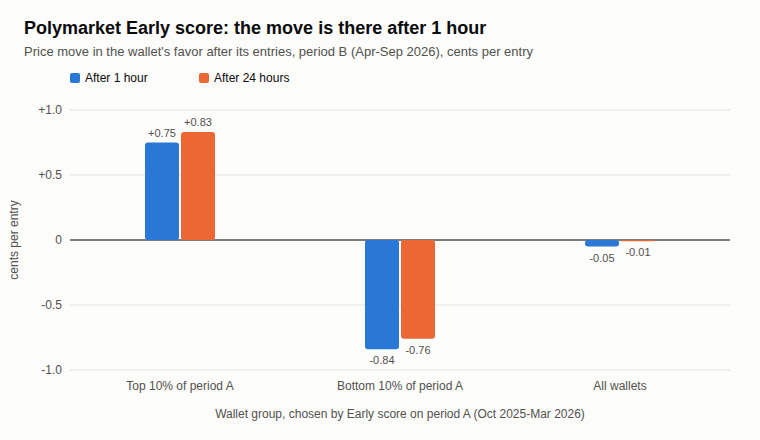
The top 10% were +0.75 cents ahead after one hour and +0.83 cents after 24 hours. Almost all of the edge is in the first hour. The bottom 10% were -0.84 cents after one hour and -0.76 after a day.
We then split each wallet's move into two parts and asked which part repeats from period A to period B. This check was not in the pre-registration and uses the 32,867 wallets with at least 3 entries on both horizons in both periods.
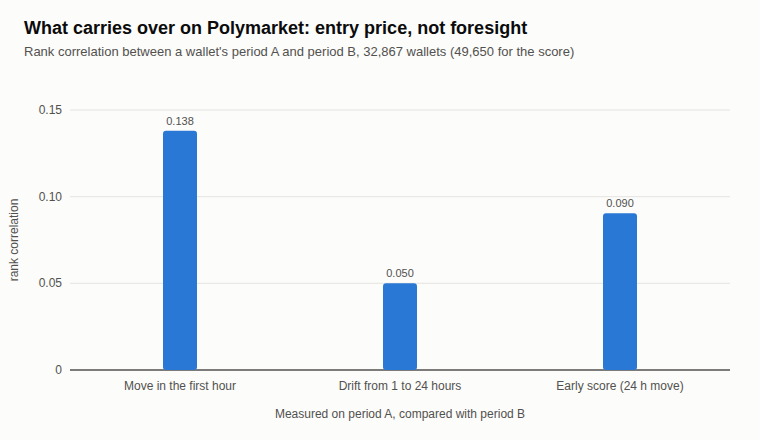
| Part of the move | Rank correlation A to B | Top 10% of A, in B | All 32,867 wallets, in B |
|---|---|---|---|
| First hour: the entry price against other traders | 0.138 | +1.16 cents | +0.06 cents |
| Drift from 1 to 24 hours: "knew it first" | 0.050 | +0.16 cents | +0.06 cents |
The first-hour gap repeats. The later drift, the part an insider score is meant to catch, barely does: the top group beats the average by about a tenth of a cent.
The split is less clean in our API check. It used 1,000 markets, scored on trades from May and June and checked from July to September 2026; most are longer-dated "by a date" markets where every group drifts up. There the top 10% led all wallets by 0.49 cents after one hour and 0.72 after 24 hours, so more than half of the lead came with the entry price and the rest later. The rank pattern was the same as on all markets: 0.214 for the first hour, 0.042 for the drift.
Polymarket wallets held to settlement, after fees
A move over 24 hours is not money. Cheap fills can still lose money if they arrive just before the price falls for a good reason. That is adverse selection, the usual way limit orders lose. This part was not in the pre-registration. We held every period B entry in a resolved market to settlement (85.9% of entries; markets still open are left out) and subtracted the fee each wallet actually paid in that market that day, taken from on-chain data.
| Group from period A | Entries | Before fees, cents per entry | Fees | After fees | t |
|---|---|---|---|---|---|
| Top 10% | 372,853 | +1.37 | 0.20 | +1.17 | 2.9 |
| Bottom 10% | 199,193 | -0.80 | 0.16 | -0.96 | -1.7 |
| Neutral | 1,244,793 | +0.14 | 0.06 | +0.08 | 0.2 |
| All wallets | 2,877,284 | +0.24 | 0.12 | +0.13 | 0.4 |
The cheap entries of the top group hold up to settlement. The bottom group is negative, though weakly (t -1.7). On the shorter API check the groups did not separate when held to settlement (top 10% +2.19 cents per entry before fees, t 1.8; bottom 10% +2.10), so treat this part as the weakest.
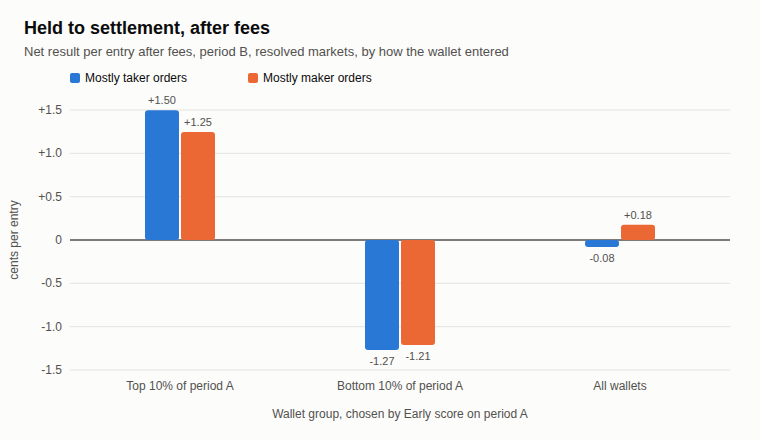
It is not a maker trick either. Makers pay no fee on Polymarket, so a group of patient limit-order traders could look good on fees alone. Split by how each entry was filled, the top 10% made +1.50 cents per entry on mostly taker entries (t 4.5) and +1.25 cents on mostly maker entries (t 2.4). The average wallet's taker entries lost 0.08 cents after fees.
Weighted by every dollar staked instead of per entry, the top 10% made about +$0.17 per $10 after fees (t 2.9). This number leans on large positions: the largest 1% of entries hold a third of the money staked and 42% of the net profit. Without the 5 largest events, the 5 largest wallets, or both, it is +$0.09 to +$0.15 per $10. Month by month it swings from -$0.04 to +$0.52 (cents per entry: -0.67 to +2.26). We lead with cents per entry because that is the unit the pre-registration used. By the dollar, all wallets together lost $0.025 per $10 after fees (t -4.4).
By entry price, before fees, the top 10% beat the average of all wallets by 1.2 to 2.4 cents in four of five price buckets. Above 0.95, where a third of their entries sit, there was almost no difference (-0.1 cents). Part of the raw profit at 0.50 to 0.80 is the well-known favorite-longshot bias: all wallets buying there averaged +3.5 cents, the top group +5.9.
Why we did not ship it as a Polymarket insider label
The score did what we asked of it on paper and still answered a different question. It found wallets that get good prices. Whether they know anything first, it cannot tell. In a market where such labels get screenshotted and shared, a label like "early" or "insider" next to an address would mislead: what repeats in the group is the entry price.
We keep the result and drop the label. A second measure, how often a wallet beats the price it paid once entry price is accounted for, has its own pre-registration.
Methodology
- Data. Every on-chain Polymarket trade in our database, October 2025 to September 2026, excluding exchange and adapter contracts. Sports, esports and Up or Down markets excluded by category, slug and question text.
- Periods. Score on period A (October 1, 2025 to March 31, 2026), outcome on period B (April 1 to September 30, 2026), the same wallets.
- Statistics. Means per entry, with entries weighted by size up to $10,000; t-statistics with standard errors clustered by event; robustness without the 5 largest events and without weather markets.
- Settlement. Payout 1 or 0 for the side held, minus the entry price. Markets still open at the end of the data are left out (14.1% of entries).
- Fees. The fee each wallet paid, from on-chain data. Polymarket charges takers only, per share a category rate × p × (1 - p), per the Polymarket fee docs (schedule as of October 2026); geopolitics markets are free. Maker and taker rebates are not added, so the result after fees is conservative.
- Pre-registration. The rule file with its dated changes is summarized in METHOD.md in the repository.
Check it yourself
The repository has the aggregated tables behind every number here and scripts/early_score_check.py, which rebuilds entries, scores and the period test from the OrcaLayer API with the Python standard library. It needs a Premium API key; the default run on 1,000 markets took about 11,700 requests and under two hours. The API's trade history starts on May 1, 2026, so the script scores wallets on trades from May and June and checks them from July to September, on a fixed list of markets. Compare the groups with all wallets, not with zero: on those markets every group drifts up. The README lists the differences and our own results for the same setup.
What this does not cover
- Individual wallets. We report groups only and publish no ranking and no addresses.
- Sports. A sports version would need the move before kick-off, which is a different measure.
- Copying these wallets. A copy trades after them and does not get their price; our whale copy-trading backtest shows what that costs.
- Markets still open at the end of September 2026.
Takeaways
- A score built to find early movers on Polymarket mostly finds good fills. On all markets nearly all of the edge shows up within an hour; in our smaller API check on longer-dated markets, more than half.
- Good fills do repeat. The top 10% of one half-year made about +1.2 cents per entry after fees in the next, on both taker and maker entries.
- Pre-register, then look at the mechanism. Our score passed its own test and would still have told users the wrong story.
FAQ
Can you detect insider trading on Polymarket from on-chain trades?
Not with a price-move score. We scored 355,732 wallets by how far the price moved their way in the 24 hours after they traded, then checked the same wallets six months later. The top 10% kept a small edge, but most of it was already there one hour after the trade. What carried over was mostly the price they paid.
What is the Early score?
A wallet score we built at OrcaLayer: the average price move in a wallet's favor 24 hours after each of its entries, shrunk toward zero for wallets with few entries and turned into a percentile from 0 to 100. Sports and short Up or Down markets were left out. We wrote every rule down before the test, and the score was never released on the site, in the API or in MCP.
Do wallets that bought well in the past keep doing it on Polymarket?
A little. Held to settlement from April to September 2026, the top 10% of wallets from October 2025 to March 2026 made +1.17 cents per entry after fees (t 2.9), against -0.96 cents for the bottom 10%. Weighted by every dollar staked instead, it is about +$0.17 per $10 (t 2.9), or +$0.09 to +$0.15 without the largest events or wallets.
Do Polymarket fees apply outside sports and crypto?
Yes, on many categories. Only takers pay: fee = shares × rate × p × (1 - p), where p is the share price. The rate is 0.04 for politics and finance, 0.05 for economics and sports and 0.07 for crypto; geopolitics markets are fee-free. We used the fee each wallet actually paid, from on-chain data.
See also: Polymarket whale trackers compared, Polymarket strategies that don't work and Polymarket live football: late goals and stop-losses. To see how individual wallets trade, open any address from the OrcaLayer leaderboard.
This is research, not financial advice.