Can an AI swarm running on Claude Opus 5.5 forecast Polymarket better than Claude itself? Three weeks ago we gave the open-source MiroFish AI swarm cheap language models and four live Polymarket markets. It answered almost every question with something between 20 and 55, and the whole test cost $5.96. The obvious objection: the agents were cheap.
So we ran it again on Claude Opus 5.5, with the same engine and four new markets. This time it cost $98.56.
Every forecast was locked on October 24-25, before any of the four markets resolved, and one thing was already clear: the Opus swarm says what Opus says. On all four markets the swarm's median agent landed within 0 to 3 points of one plain Opus answer to the same question, built from the same news. A swarm run cost about $14 to $24. The plain answer cost about 2.5 cents.
TL;DR
- One opinion, again. Opus swarm vs one direct Opus answer: 52 vs 49 (Toronto), 40 vs 38 (Likud), 45 vs 45 (Bank of Canada), 85.5 vs 84 (Iran).
- Open questions stay open. On Toronto, Likud and the Bank of Canada, Opus and its swarm sit between 38 and 52 while the market prices 65.5, 30.5 and 18.7. Where Opus is confident (Iran, 84), the swarm is confident too.
- The report overstates the swarm. On the Bank of Canada, MiroFish's three report agents said 89 to 93 and the Opus report described a consensus on "no move". The agents' own medians were 45 to 55.
- Even Opus writes wrong personas. About 130 factual errors across four markets, several on the exact fact the market turns on. We fixed them by hand and publish the list.
- Two big disagreements to watch. The Bank of Canada market prices a hold at 18.7%; smart wallets have 96.5% of their dollars on a hold. Toronto: 65.5% vs 86.8%.
- Scorecard coming. The last of the four windows closes on October 31, 2026. We will score every source.
What changed since round one
Round one used five cheap models (Gemini 3.8 Flash, GPT-6 Luna, Qwen 3.8 Flash, DeepSeek V4.1 Flash, GLM-5.3 Flash). Its main findings: mixing five models changed nothing, the swarm defaulted to "no official confirmation yet", and its answers depended on how the seed files were written.
This round keeps the engine and changes the model, the questions and the inputs:
- Same engine: MiroFish at the same commit, Reddit-style feed only, 25 rounds, one action per agent per round, in an isolated container with no access to OrcaLayer's database.
- Opus builds the world: the knowledge graph, the agent personas and the simulation setup were generated by Claude Opus 5.5, once per market.
- Three models on the same personas: on those exact personas and opening posts we ran the swarm with every agent on Opus 5.5, then on Haiku 5.5, and, for Toronto and the Bank of Canada, on Sonnet 5.5. Only the model behind the agents changes.
- A plain baseline: each model was also asked the question directly, five times, with the same seed files and instructions. No swarm, just the model answering on its own; we report the median of the five.
- Better questions: every question carries the run date, the exact deadline and Polymarket's resolution rule restated in full: what counts as YES and what does not.
- Clean inputs: seed files were written from public reporting with a date in every sentence. No prediction-market prices and no forecast-model probabilities went in. Polls, official data and statements did.
The markets
We picked four liquid, news-driven markets outside sports, each resolving within a week of the run. On two of them OrcaLayer's Smart Money disagreed sharply with the price.
| Market | YES means |
|---|---|
| Toronto mayor | Olivia Chow wins the October 26 election |
| Israel | Likud's own list wins the most Knesset seats in the October 27 election |
| Bank of Canada | The overnight rate stays at 2.25% on October 28 (any move is NO) |
| US x Iran | No qualifying US air or missile strike hits Iranian territory by October 31, 11:59 PM Iran time (ground raids, naval gunfire and intercepted munitions don't count) |
Claude Opus 5.5 vs Polymarket: the forecasts, locked in on October 24-25, 2026
All numbers are the probability of YES, in %.
| Source | Toronto | Likud | Bank of Canada | US x Iran |
|---|---|---|---|---|
| Polymarket at the snapshot | 65.5 | 30.5 | 18.7 | 82.5 |
| Smart Money, wallets on YES | 47.7 | 24.9 | 39.3 | 67.1 |
| Smart Money, money on YES | 86.8 | 29.4 | 96.5 | 93.7 |
| Opus 5.5, asked directly | 49 | 38 | 45 | 84 |
| Sonnet 5.5, asked directly | 52 | 30 | 50 | 80 |
| Haiku 5.5, asked directly | 48 | 33 | 45 | 80 |
| Swarm on Opus 5.5 | 52 | 40 | 45 | 85.5 |
| Swarm on Sonnet 5.5 | 50 | not run | 49.5 | not run |
| Swarm on Haiku 5.5 | 50 | 25 | 55 | 78 |
| MiroFish report agent (Opus swarm) | 60 | 40 | 89 | 74 |
Swarm figures are the median agent probability after the simulation. Direct figures are the median of five answers. Agents per swarm: 36, 56, 34 and 52. Snapshots (UTC): Toronto October 24 10:46, Likud 11:29, Bank of Canada 11:57, Iran October 25 09:56.
The spread inside each Opus swarm: Toronto 45 to 58, Likud 32 to 60, Bank of Canada 40 to 75, Iran 60 to 93.
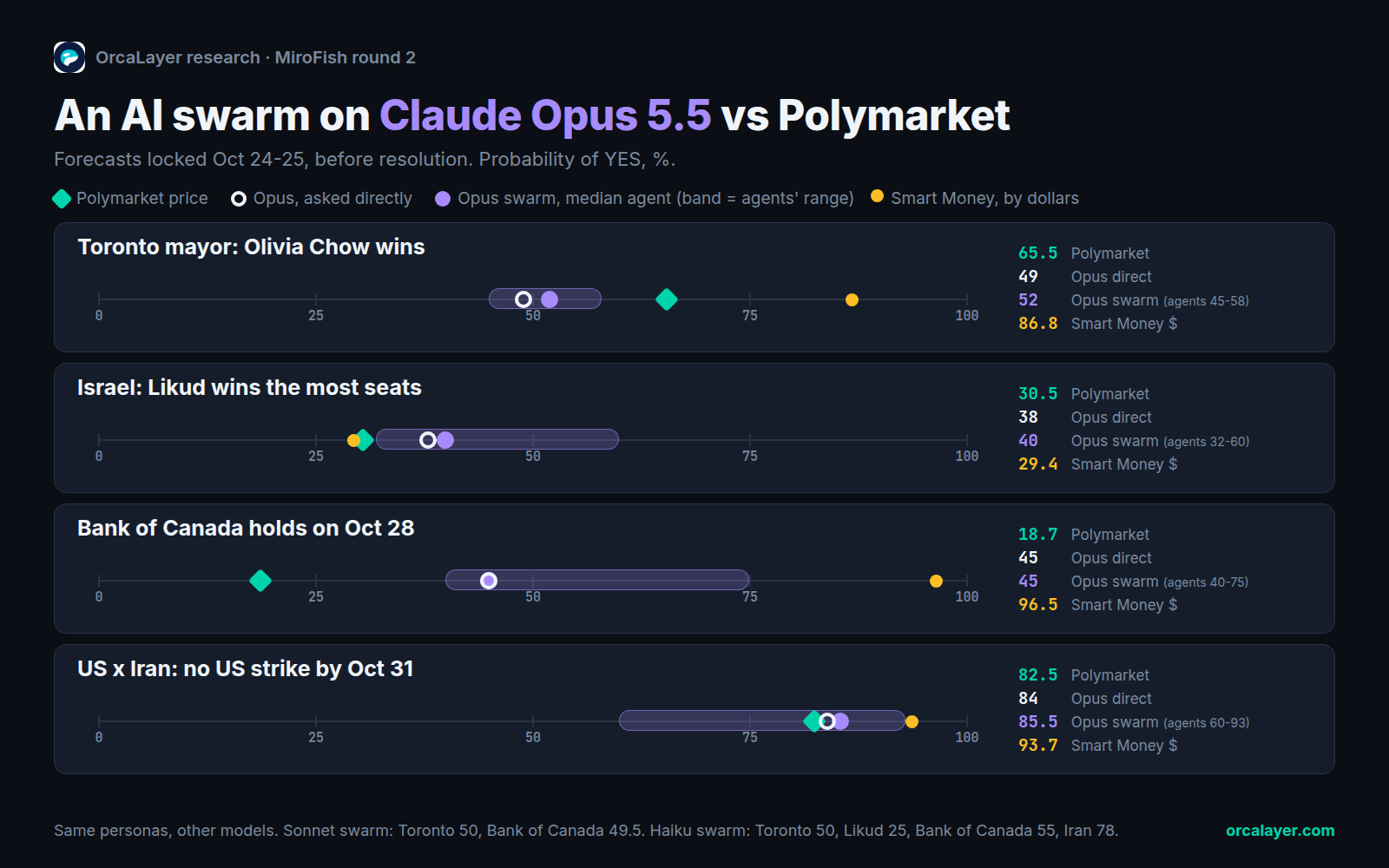
Finding 1: the AI swarm on Claude Opus says what Claude Opus says
The idea behind a swarm is that dozens of agents with different roles, reading and arguing with each other, find something a single reading misses.
On the four markets the Opus swarm landed 3, 2, 0 and 1.5 points from one direct Opus answer. Sonnet behaved the same way: 50 vs 52 on Toronto, 49.5 vs 50 on the Bank of Canada. In round one, repeat runs of the same setup moved the median by up to 10 points, so differences of 0 to 3 points from a single run are within run-to-run noise. We spent this round's budget on Opus rather than on repeats.
Haiku drifted further from its own direct answer: 25 vs 33 on Likud and 55 vs 45 on the Bank of Canada, while staying close on Toronto (50 vs 48) and Iran (78 vs 80). Even 8 to 10 points is inside the run-to-run noise we saw in round one.
The reason is the one we saw in round one. Every persona is written from the same seed files by the same model, so the agents share facts, framing and gaps. The posts read better on Opus, but every agent still argues with versions of the same model.
Finding 2: the middle comes from the model
In round one the swarm sat at 20 to 55 on almost everything, and we read that as the swarm collapsing to a default. Round two shows where the middle comes from.
On Toronto, Likud and the Bank of Canada, Opus asked directly gives 49, 38 and 45. These are close calls in the news we gave it: Toronto polls disagree (Bradford ahead in three October polls, Chow by 3 to 11 in Nanos and Pollara), Israeli pollsters fall into two camps, and 19 of 34 economists in a Reuters poll expected a Bank of Canada hike while the rest did not. The Opus swarm follows: 52, 40, 45. On Iran, where the seed files describe eight weeks without a confirmed US strike and a president who told aides he would wait until after the midterms, Opus says 84, and the swarm says 85.5.
The Opus swarm inherits the model's view of the evidence instead of inventing caution. Whether that view beats the market is what the scorecard will tell.
Finding 3: MiroFish's report overstates its swarm
MiroFish ends each run with a report agent that writes a summary and gives its own number. On the Bank of Canada all three report agents said 89 to 93, and a chapter of the Opus report was headed "Agent Consensus: Banks and Economists Converge on 'No Move'".
Polled one by one, the agents answered with a median of 45 (Opus), 49.5 (Sonnet) and 55 (Haiku), and only 13 of 34 Opus agents put YES above 50. In our runs the report agent tried to interview the agents, but the simulation had already shut down, so it wrote from the knowledge graph built from the seed files and never saw the agents' answers. If you use MiroFish as a forecaster, poll the agents.
Finding 4: Claude Opus writes wrong personas too
Before every run we checked each generated persona against the seed files with a second model, then by hand. Even on Opus 5.5 the generator wrote about 130 factual errors across four markets. Most were minor; several touched the exact fact the market turns on:
- Israel: six personas placed the election in November (three of them on November 4, the deadline for official results) instead of October 27. Three reversed the preferred-PM poll: the seeds say Eisenkot leads Netanyahu 49 to 41; the personas had Netanyahu ahead.
- Bank of Canada: several personas said the Bank of Canada had already hiked on September 16. That was the Federal Reserve (and the ECB); the Bank of Canada has held at 2.25% since October 2025. Others called a hold "the consensus" while 19 of 34 economists in the Reuters poll expected a hike.
- Toronto: a poll's Scarborough sub-result (Chow 49, Bradford 48) became its overall result in five personas; overall that poll had Bradford ahead 49 to 47. The generator also turned "Ford" into the official account of a "Ford mayoral campaign". No Ford was running.
- Iran: several personas described the April ceasefire as still in effect, though the June memorandum collapsed in July and no truce has been in force since. The opening posts mixed up voices: the "US president" account ordered Israeli forces to bring down the regime in Tehran.
The generator also likes to end its setup with a verdict ("leave a slight edge to Chow", "the narrative should drift toward cautious confidence that the pause holds"). We removed those sentences and 11 opening posts with wrong facts, swapped voices or a ready-made verdict, as in round one. The originals, the corrections and the reasons are in the repository.
A better model does not remove the need to check what it generates. Left uncorrected, several of these errors pointed the swarm toward one answer.
Finding 5: what an AI swarm on Claude Opus costs
| Toronto | Likud | Bank of Canada | US x Iran | |
|---|---|---|---|---|
| Agents | 36 | 56 | 34 | 52 |
| Preparation on Opus (graph, personas) | $2.58 | $4.21 | $2.68 | $3.94 |
| Swarm run on Opus 5.5 | $13.73* | $24.00 | $13.63 | $18.91 |
| Swarm run on Sonnet 5.5 | $3.65 | not run | $3.82 | not run |
| Swarm run on Haiku 5.5 | $0.23 | $0.56 | $0.27 | $0.45 |
| Five direct answers, Opus 5.5 | $0.13 | $0.14 | $0.13 | $0.12 |
*Includes about $0.80 of a first attempt we stopped after one round to fix a persona.
All figures include prompt caching. Every agent re-sends its persona, the tool list and its history on every turn; caching cut the Opus bill by about 40%. Without it an Opus run would have cost about $23 to $40.
The whole round, including persona checks, cost $98.56 by our API meter: 16.5 times round one ($5.96). One Opus swarm run cost 500 to 900 times one direct Opus answer.
What this doesn't show yet
- Everything above is what the forecasters said on October 24-25. Who was right comes after resolution.
- Eight markets across two rounds are an illustration, not a statistic. Eight resolutions can't rank forecasters.
- One run per configuration, and run-to-run noise in round one was up to 10 points.
- Smart Money is positioning. On the Bank of Canada, 39.3% of smart wallets hold YES, and they hold 96.5% of the smart money in the market. Neither number is a probability.
- Hand corrections: an uncorrected swarm might have behaved differently. We publish both the originals and the fixes.
Who will be right: scoring AI forecasts against Polymarket
Toronto votes on October 26 and Israel on October 27 (official results by November 4). The Bank of Canada decides on October 28 at 9:45 AM ET, and the Iran window closes at 11:59 PM Iran time on October 31. For every source in the table we will publish the Brier score, (p − outcome)², and the absolute error, |p − outcome|, with p as a probability from 0 to 1, market by market, Smart Money included.
The two markets worth watching are the ones where the money and the price disagree. On the Bank of Canada the price gives a hold 18.7%, smart wallets have 96.5% of their dollars on a hold, and every model and swarm sits in between. On Toronto: price 65.5, smart-money dollars on Chow 86.8, models near 50.
GitHub's own event log records the push of these forecasts (commit 7d32268) at 17:14:59 UTC on October 25, 2026, and the repository was made public on October 26 at 12:26 UTC, before any market resolved: forecasts.csv at that commit. The Wayback Machine archived that file and the event log at 12:33 and 12:34 UTC on October 26. The repository holds every forecast, question, prompt, seed file, persona correction and removed opening post: orcalayer/ai-swarm-vs-polymarket.
The takeaway so far
Putting a frontier model behind every agent costs 500 to 900 times more than asking that model once, and on these four markets it did not make the swarm a different forecaster from the model it runs on. If you want what Opus thinks, ask Opus once.
OrcaLayer tracks something a model can't read from the news: where wallets with real money are positioned on every open Polymarket market. See the Smart Money leaderboard.
FAQ
Does a smarter model make an AI swarm forecast better? Not in what we can see before resolution. On four live Polymarket markets, a MiroFish swarm running on Claude Opus 5.5 landed within 0 to 3 points of a single direct Opus answer to the same question with the same news: 52 vs 49, 40 vs 38, 45 vs 45 and 85.5 vs 84. In our first round, repeat runs of one setup moved by up to 10 points, so a gap this small is within run-to-run noise. Accuracy against outcomes will be published after the markets resolve.
How much does an AI swarm on Claude Opus cost? One MiroFish run on Claude Opus 5.5 with 34 to 56 agents and 25 rounds cost about $14 to $24 in API fees with prompt caching, and would have cost about $23 to $40 without it. One direct Opus answer to the same question cost about 2.5 cents. The whole round, four markets with preparation, persona checks, ten swarm runs and sixty direct answers, cost $98.56.
What is MiroFish? MiroFish is an open-source swarm simulation engine (AGPL-3.0). It turns the people and organizations in your documents into LLM agents with personas, lets them post and argue on a simulated social network built on CAMEL-AI's OASIS, and writes a report. We tested it as a forecaster on Polymarket markets, first with cheap models and now with Claude.
Can I trust the agent personas MiroFish generates? Check them first. Even on Claude Opus 5.5, the persona generator wrote about 130 factual errors across four markets: an election moved to November in six Israeli personas, a preferred-PM poll with the leader reversed, the Bank of Canada confused with the Federal Reserve and the ECB, and a mayoral campaign for a person who was not running. We fixed them by hand before running and published every correction.
Is Smart Money on OrcaLayer a probability? No. OrcaLayer's Smart Money figures show the share of smart wallets, or of their invested money, holding YES in a market. They describe positioning rather than the probability of the event, and should not be compared with the market price one to one.
When will the results be known? Toronto votes on October 26 and Israel on October 27, 2026. The Bank of Canada announces its decision on October 28 at 9:45 AM ET, and the Iran window closes at 11:59 PM Iran time on October 31; that market can stay open up to three more days if reports conflict. We will publish the Brier score and absolute error of every source after they resolve.